Consumer's FAQ

Frequently Asked Questions & Tutorial Videos

Transition from Imperial Gallon (IG) to Cubic Metre (m³)

1. Why is DEWA changing water consumption measurement unit from imperial gallon (IG) to cubic metre (m³)?
In compliance with Cabinet Resolution No. (85) of 2023 and Resolution No. (43) of 2024, issued by the Ministry of Industry and Advanced Technology, DEWA is discontinuing the use of the imperial gallon (IG) unit in water meters. This aligns with international best practices for standardisation and measurement.

2. What is the benefit of using the cubic metre unit (m³)?
The cubic metre is an internationally recognised and standardised unit of measurement. It ensures greater accuracy, enhances operational efficiency and simplifies comparison with global benchmarks. Using the cubic metre enhances transparency, consistency and comparability across industries.

3. When will DEWA start using the cubic metre unit (m³)?
DEWA will adopt the cubic metre as the standard unit for measuring water consumption starting March 2025 billing cycle

4. Will DEWA need to replace my water meter?
No, DEWA will not replace your water meter. The existing water meters are compatible with the cubic metre measurement system.

5. How do I convert my water consumption from IG to cubic metre and vice versa?
To convert your water consumption from Imperial Gallon IG to cubic metres (m³), you can use the following formula:
1 cubic metre (m³) = 219.9692 (IG).
For example, 4.16 cubic metres (m³) = 915 (IG).

6. Will this change require me to update my records or contracts?
No, customers do not need to take any action regarding their records or contracts. The change will automatically reflect in DEWA’s billing and reporting systems.

7. Will I be notified before the change takes effect?
Yes, DEWA will notify all customers well in advance of the change through official channels, including SMS, email, and the DEWA app.

8. Who do I contact if I have any questions regarding this change?
You can find more information on DEWA website, mobile app, or by contacting DEWA’s Customer Care Centre at 04-601 9999

D33 Industry Friendly Power Policy

1. What is the Dubai Economic Agenda D33?

The Dubai Economic Agenda D33 aims to double the size of Dubai's economy within a decade and position it among world’s top three global cities. It comprises 100 transformational projects aimed at driving economic growth and development.
 

2. What is D33 Industry Friendly Power policy?

The D33 Industry Friendly Power policy aims to:

  • Allow industry to reduce cost of doing business and achieve clean energy targets.
  • Enable Dubai to accelerate decarbonization and achieve net zero, while reducing dependence on natural gas for production of electricity.
  • Make Dubai an attractive destination for manufacturing investments (especially smart manufacturing) and generate an additional D 58 billion of Manufacturing-Value-Added by 2033.

3. Who is eligible for the D33 Industry Friendly Power policy benefits?

To be eligible for the D33 Industry Friendly Power policy benefits, companies must obtain a D33 eligibility certificate issued jointly by Dubai Economy and Tourism Department (DET), Department of Finance (DOF) and DEWA. This certificate is available for industrial customers, Agri-tech enterprises and Data Centers, who are currently securing (or plan to secure) 100% of their total energy requirement from DEWA grid and from new captive PV solar generation.

4. What are the benefits of the D33 Industry Friendly Power policy?

Under this policy, DEWA is offering pioneering programs and benefits as follows:

  • an additional distributed renewable resources (solar PV) generation beyond current Shams Dubai initiative.
  • 25% Reduction in New Connection Charges and an interest-free credit facility to pay the charges in 2 years or by date of energization, whichever is earlier.
  • Priority for I-RECs Purchases

5. What is the validity period of D33 Eligibility Certificate?

The validity of D33 Eligibility Certificate is 10 years from the date of its issuance.
 

6. What happens when excess feed-in power is generated by D33 customer?

Feed-in power generated by D33 Companies will be procured and compensated by DEWA at a flat rate of 10.5 Fils/kwh, subject to certain conditions. E.g., No payment will be made for feed-in power during the winter season, (from December to February) or during emergencies or system maintenance/other grid constraints, or where it exceeds the permitted maximum load in that plot. Feed-in power in violation of applicable conditions will not be eligible for payment.
 

7. What is the process for new connections under the D33 Industry Friendly Power policy?

Eligible D33 Companies applying for new connections are entitled to a flat 25% discount on the standard DEWA connection charge. Discount is not applicable for connections for fit-out, temporary/construction connections, Solar PV connection, equipment rental etc. Companies are eligible for an interest-free credit period to pay the connection fee. The credit period is 2 years from the date of DEWA Estimate or until the date of connection/energization, whichever is earlier. A bank guarantee from a local bank in the prescribed format is required to be submitted by the Customer soon after he receives the DEWA Estimate.

Amazon Alexa

Dubai Electricity and Water Authority (DEWA) is providing its services on Amazon’s Alexa in Arabic, becoming the first government utility in the world to do this.

Why is DEWA Skill available on Amazon Alexa?

DEWA has announced the launch of the Rammas AI service on Amazon’s Alexa smart voice system. DEWA has become the first government entity to add its virtual employee to this innovative technology, in adherence with the directives of the wise leadership to reduce the number of visitors to government establishments by 80% and encourage the public to use smart services. This supports the Smart Dubai initiative, which aims to transform Dubai into the smartest and happiest city in the world.

Rammas acts as a virtual employee, making use of artificial intelligence technology to answer customer enquiries. Rammas is characterised by its ability to learn and understand the needs of customers, according to their enquiries. Rammas analyses these based on available data and information and takes action to accurately answer all queries.

1. How can I download DEWA Skill on Amazon Alexa?

Download Alexa Application on your mobile and search for DEWA Skill in “Skills & Games” option.

https://www.amazon.com/DEWA/dp/B06X19S89K

2. How can I open DEWA Skill in Alexa?

After enabling DEWA Skill, you can invoke DEWA Skill by saying: Alexa, open DEWA

3. Are all services that are available on the mobile application also available on Amazon Alexa?

No, you can ask about consumption details, bill balance and general FAQs related to DEWA services

4. How can I change the language of DEWA skill on Amazon Alexa?

You can follow the steps from Amazon website: https://www.amazon.in/gp/help/customer/display.html?nodeId=G96ABGB2ASX5M2NK

Note: Skill language will change based on the device language

5. What are the languages supported on DEWA Skill on Amazon Alexa?

Arabic and English

6. What are the services available in DEWA Skill on Amazon Alexa?

 You can ask about consumption details, bill balance and general FAQs related to DEWA services

7. How can I link my DEWA account with Amazon Alexa?

1. Open your Amazon Alexa app or website.

2. Open your DEWA Skill

3. Open Skill settings

4. Choose account linking

5. Enter your credentials and login in DEWA website

6. Your account is now linked


Clearance certificate

1. How can I submit an online request for a clearance certificate?

To apply for a clearance certificate, visit the Clearance Certificate page

2. What are the requirements for submitting a request for clearance certificate?

  • Passport copy or Emirates ID for Individuals
  • Trade License, for companies only
  • Account Number
  • Outstanding dues /Final bill amount settled

3. What rules do I have to follow while filling in the online request for a clearance certificate?

The required fields must be filled in (required fields are either in red or marked with an asterisk). Kindly note that the customer must apply for the De-activation of Electricity/Water (Move Out) service before requesting a clearance certificate. For owners selling their property, a clearance certificate can be requested before applying for the De-activation of Electricity/Water (Move Out) service and settling any outstanding dues at the premises.

4. How will I know if there are data entry errors in my online application for a clearance certificate?

Error messages will appear before the form can be submitted.

5. What happens when I successfully submit my request for a clearance certificate?

Upon settlement of your final bill, DEWA will send the clearance certificate to your registered email.

6. How can I download a clearance certificate?

Visit the Clearance Certificate page and select Verify Clearance Certificate.

7. How can I get more information

For more information about this service, please visit the Help & Support page.

8. What do I do if I face issues when applying for the service?

Please visit our Help & Support page for assistance.


Inflation Allowance

1. What is the Inflation Allowance?

The Inflation Allowance is a government subsidy disbursed to Emirati families with low incomes to handle inflation occurring worldwide and the rise in prices of fuel, basic foodstuffs, electricity and water.

2. Who is eligible for the Inflation Allowance on DEWA Electricity & Water consumption?

UAE National customers identified by the Ministry of Community Development (MOCD) are eligible for inflation allowance

3. What is the amount of Inflation allowance on DEWA Electricity & Water Consumption?

The amount of Inflation allowance is D 400 or actual bill amount of the current month, whichever is less.

4. How can UAE National customers apply for Inflation Allowance on DEWA Electricity & Water consumption?

UAE National customers need to apply for the Inflation Allowance service on the website of Ministry of Community Development (MOCD). If MOCD approved customers’ request, MOCD will share the customers’ data with DEWA for granting the Inflation allowance

5. Is the customer eligible to get the Inflation Allowance on DEWA Electricity and Water consumption, if he/she is getting the social allowance on DEWA Electricity consumption?

No, as per the rules and regulations of MOCD, customers who are getting the social allowance on DEWA Electricity consumption, are not eligible for Inflation Allowance.

6. For any inquiry related to the eligibility of Inflation Allowance, who is the point of contact for the customers?

In case of any inquiry related to the eligibility of Inflation Allowance, customers should contact Ministry of Community Development (MOCD) at Toll Free: 800623

7. If an eligible customer currently getting inflation allowance decides to shift from one premises to another in Dubai, what will happen to the inflation allowance?

Inflation allowance will be discontinued on DEWA Electricity & Water consumption, once customer Moves-out from the premises. For availing the inflation allowance for the new premises, the customer needs to re-apply for the service on the website of Ministry of Community Development (MOCD). If MOCD approves, they will share customer data with DEWA for granting the Inflation allowance on DEWA Electricity and Water consumption.


Request for Electricity Supplies for Tents

Time required to deliver this service:

Wedding:

  • One day before the event 

    (If Application submitted 4 days before the event and estimated cost is paid).

Mourning:

  • Within 4 hours (LV Cable to be laid)

    (Free of Cost for 3 days for one tent)

How can I submit an application?

DEWA offers different channels to submit an application:

  • DEWA’s smart app

  • DEWA’s website (Go to ‘Services’ then ‘Smart Response’)

  • DEWA’s emergency number 991 

How can I track an application?

You can track your application by using one of the below channels:

  • DEWA’s smart app

  • DEWA’s website (Go to ‘Services’ then ‘Smart Response’) or (from ‘Help & Support’ tab then ‘’Smart Response’)

  • DEWA’s emergency number 991

Can I avail Electricity for more than three days in case of supplies for Mourning?

Electricity for Mourning is free of cost for 3 days. After that standard charges may apply.

Mode of Payment in case applicant need to pay for Services.

Please note that Electricity Supplies for Mourning Tent is Free of Cost for 3 days.

For payment for Wedding, it is advisable to debit the charges to applicant’s DEWA Customer Account Number.

How can I Make application for tents in case of Mourning?

You can contact Govt initiative channel and all other arrangements for Mourning case tents will be done by respective department and Tent Providers.

Are there any NOCs required to submit to DEWA before getting electricity supplies?

There are different reasons to Submit NOCs to DEWA before getting Electricity Supplies release:

  • Civil Defense NOC in case supplies required for tents.

  • RTA NOC is required if there is Road Crossing is required while LV Cable Laying

Are there any reasons where delay may happen in getting electricity supplies released?

DEWA has a standard stipulated time frame for electricity services based on the events, but there are chances for delay in getting electricity supplies for tents if below conditions are not fulfilled by applicants or by the representative of applicants:

  • If the location of tent is not finalised at the time of first visit of DEWA staff

  • If the customer side / supplies side arrangement is not done by tent services company or by applicants

  • If Civil Defense and/or RTA NOC is required and not submitted on time.

  • If no representative available from applicant side while releasing electricity supplies 

  • If safety standards are not maintained by applicants or Tents Service Provider.

What comprises of Estimated cost for getting Electricity Supplies?

Electricity Supplies for Mourning is Free of Cost. For other events, cost calculations depend on below:

  • Service Charges – fixed based on load applied

  • Energy Consumptions charges depends on the days of electricity supplies required

What do I do if I face issues when applying for the service?

Please visit our Support page for assistance

EV Green Charger

1. What is The Electric Vehicle (EV) Green Charger?

The EV Green Charger Initiative was launched in support of HH Sheikh Mohammed bin Rashid Al Maktoum’s vision to make Dubai the smartest and happiest city in the world and promote green transportation in the city. The aim of this project was to set up an electric vehicle charging infrastructure for the public across Dubai. At the time of the launch of the initiative there were a very limited number of electric vehicles in Dubai mainly because there wasn’t an electric vehicle charging infrastructure. DEWA, as the only electricity provider for Dubai, took the lead in setting up electric vehicle charging stations to encourage the public to switch over from petrol to electric vehicles: helping to achieve Dubai’s carbon abatement strategic target of carbon reduction by 16% by 2021 and reduction in other emissions. 

2. Since the launch of the initiative in 2015, what progress has been made so far?

Dubai Electricity and Water Authority (DEWA) announced in June 2021, the completion of the third phase of its EV Green Charger initiative, which included the installation of an additional 100 EV Green Charger stations for charging electric vehicles across Dubai. With the completion of this phase, DEWA’s electric vehicle charging network has expanded to 300 charging stations. Currently over 400 charging stations have been installed in different areas of Dubai such as government offices, airports, petrol stations, shopping malls, commercial offices, clinics and hospitals, residential complexes, and establishments. This initiative contributes towards DEWA's efforts to encourage the use of environmentally friendly electric vehicles in the emirate in order to reduce carbon emissions and support sustainable modes of transport in Dubai.

3. What regulations are in place regarding the establishment and installation of electric vehicle charging stations in Dubai?

HH Sheikh Ahmed bin Saeed Al Maktoum, Chairman of the Dubai Supreme Council of Energy, issued Directive number 1 of 2017 on the establishment and installation of electric vehicle charging stations in Dubai. This directive states that all public and private organisations and developers in Dubai must get approvals from DEWA before establishing, installing, operating or maintaining any electric vehicle charging station. In turn, DEWA will coordinate with Dubai Municipality (DM) and the Roads and Transport Authority (RTA) to ensure that electric vehicle charging stations meet the technical requirements and standards adopted by the relevant authorities.

The Supreme Council of Energy issued Directive number 1 of 2016 to set a target for the government, at least 10% of all newly-purchased cars will be electric or hybrid from 2016 to 2020. The proportion of electricand hybridcars will rise to 2% by 2020, and 10% by 2030. 

Moreover, in 2020, the Dubai Supreme Council of Energy issued Directive number 2 of 2020, it updates the targets on the purchase of green vehicles by Dubai Government entities. The directive increases the annual government procurement target for EVs and hybrid vehicles to 20% starting from 2025, with a further increase to 30% starting from 2030.

4. How does this initiative support the sustainable development of Dubai?

The EV Green Charger Initiative is one of three smart initiatives launched by DEWA to support the Smart city vision of Dubai. By developing smart EV charging infrastructure across Dubai, DEWA aims to make its stakeholders happy, minimize environmental impact, and enable a smart city. The initiative also supports the Dubai Plan 2021, for a smart and sustainable city, and is aligned with the UAE Vision 2021 to make the UAE amongst the best countries in the world. The EV Green Charger initiative will also help achieve the Carbon Abatement Strategy where Dubai has a target to reduce CO2 emissions by 16% by 2021.

5. How many EV Green Charger stations / charge points have been installed and where are they located?

DEWA has deployed more than 400 EV Green Charging Stations across the city, equivalent to around 740 charge points, as many of the chargers have dual charging outlets. The locations of which are available on DEWA website and DEWA smart applications. All new charger locations are updated regularly on DEWA’s website and the smart application. Please visit EV Green Charging Stations page for locations.

6. What are the different types of EV Green Chargers found across Dubai?

DEWA installed four types of chargers, Fast Charger, Public Charger and Wall-Box:

  • Ultrafast Charger (150 kW DC with type 2 Socket)
  • Fast Charger (43 kW AC with Type 2 Socket, 50 kW DC ChadeMO and Combo CCS Sockets). Most of these are installed at petrol stations
  • Public Charger (2 x 22 kW AC, with double Type 2 Socket) 
  • Wall-Box (22 kW AC, with single Type 2 Socket) 

For more information, please visit EV Green Charger page.

7. Where will I find assistance in using electric vehicle charging stations?

Customers can contact DEWA customer care centre on 04 601 9999. Moreover, the charging points are user friendly and have instructions on how to be used. Know more about EV Chargers Types & Instructions.

8. When are the electric vehicle charging stations available for use?

The EV Green Chargers located at the DEWA Customer Happiness Centres are available, from Sunday to Saturday during 07:30am to 12:00am.

However, charging stations located in petrol stations are available on a 24-7 basis. Please visit EV Green Charging Stations page for locations.

9. Where can I purchase an electric vehicle in Dubai and at what cost?

Please contact car dealerships for availability and costs since the prices vary for vehicles.

10. What is the typical range of an electric vehicle?

The range of the electric vehicle depends on battery capacity and type of vehicle; typically, it ranges from 200km to 700km.

11. What is a plugin hybrid vehicle?

A plugin hybrid vehicle has a regular petrol engine and with an additional electric motor. This vehicle can run on either petrol, batteries or both at the same time. It also has a plug for charging on-board batteries and can run as full electric mode with a limited range.

12. Can anyone use DEWA’s EV Green Chargers?

For registered EVs in Dubai, DEWA will create an EV account instantly, once the customer registers the electric vehicle with Roads and Transport Authority (RTA). They can utilize the charging stations within an hour of vehicle vregistration or by creating an EV account. Alternatively, customers can also create an EV account through DEWA website, Smart App or through IVR at DEWA Customer Care Centre. DEWA also will issue EV Green Charger Card and

deliver it to customers within three working days from creating the EV account.

DEWA caters to all motorists who drive an electric vehicle in the UAE, including local and international visitors by allowing them to charge their vehicle through DEWA’s “Guest Mode” feature. They can access this feature by scanning the QR code on the charging stations and following the steps on their device.

13. How can I tell when my electric vehicle is completely charged?

Check the display on our charging station or battery charge indicator on your vehicle’s display. Either one will tell you when your charging session is complete.

14. Can I discontinue the charging process before it is complete?

Yes. You can stop the charge at any time following the instructions on the charger.

15. Can I charge the battery even if it's not empty?

Yes, an electric vehicle’s battery management system actively manages the delivery of the charge to ensure the maximum lifespan of the battery. Just plug it in and let the car do the rest.

16. What do I do if the charger does not work when I place my EV Green Charger Card in front of the charger’s card reader or if scanning the QR code is not working?

You can  contact DEWA Via:

• DEWA Customer Care Centre on 04- 601 9999.

•  HAYAK Service : Online text chat with option of video chat available on DEWA website and Smart App.

17. What precautions should customers be aware of when using the EV Green Charger?

Customers should follow the instructions provided on the DEWA website and smart app to ensure safe and efficient charging. Forcefully removing the cable can cause damage to both your vehicle and the charging station, so please follow the instructions carefully. In case of emergency, please call 991.

Disclaimer: DEWA shall not be liable for any loss or damage to customer assets incurred during the use of DEWA’s public EV chargers.

18. Where can I get access to electric vehicle charging stations outside Dubai?

Currently DEWA only provides the EV Green Charger stations within Dubai.

19. How much does it cost to charge an electric vehicle?

The cost of charging the electric vehicle depends on the capacity of the battery and the use by the driver. Starting 30th September 2024, as per the Cabinet Decision No. 81 of 2024. The decision mandates the cost of charging electric vehicles at public charging stations to be (D 0.7/kWh + VAT) for AC charging, and (D 1.2/kWh + VAT) for DC charging for the EV Green Charger registered users.

DEWA have also provided a new feature ‘Guest Mode’ for non-registered customers who wish to use the EV Green Charger services and they can choose from several charging packages based on the charger type and duration. They can access this feature by scanning the QR code on the charging stations and following the steps on their device.

20. Can I install an electric vehicle charger at home? How much does it cost?

Home chargers can be installed by a third party at customers’ premises behind the customers’ meter, like any other home appliances. Approved electrical contractors by DEWA should be used for the installation of any electrical equipment within the Emirate of Dubai, including home charging stations. When charging the car at home, the electricity used is added to the normal DEWA bill at standard residential electricity rates.

21. How will I be billed when using the charging stations?

Registered customers that use DEWA’s EV Green Charger stations will be billed on monthly basis and they can pay using methods of bill payment provided by DEWA.

Starting 30th September 2024, as per the Cabinet Decision No. 81 of 2024. The decision mandates the cost of charging electric vehicles at public charging stations to be (D 0.7/kWh + VAT) for AC charging, and (D 1.2/kWh + VAT) for DC charging for the EV Green Charger registered users, which is a great saving compared to fuel-powered cars.

DEWA have also provided a new feature ‘Guest Mode’ for non-registered customers who wish to use the EV Green Charger services and they can choose from several charging packages based on the charger type and duration. They can access this feature by scanning the QR code on the charging stations and following the steps on their device.

22. What documents are required to register with DEWA?

  • For Individuals outside Dubai, you need to provide your Emirates ID and vehicle license
  • For Individuals outside the UAE, you need to provide Passport and vehicle license

23. Can I use my card for more than one vehicle?

Yes, but any use of the card will be charged to the card owner when applicable.

24. I sold my car. What do I need to do to deactivate my EV Green Charger account?

You need to apply for deactivation of your EV Green Charger account to receive your final bill, through “Deactivate EV Green Charger Account on DEWA website, DEWA Smart Application, and through IVR at Customer Care Centre (04-6019999).

Accordingly the EV Green ater account and I have an excess amount due. Can I transfer the excess amount to my electric vehicle account number and vice versa?

Yes, you can transfer the excess amount to your other account under the same Business Partner.

28. What should I do if my EV Green Charger card is lost or damaged, or if I have any problem while charging?

  • You can do one of the following options:
  • Call our customer care centre on 04 601 9999
  • email: customercare@dewa.gov.ae
  • Use HAYAK service
  • You can also charge your electric vehicle without the physical card. Just scan the QR code at DEWA’s EV Green Charger stations using DEWA’s smart app.

29. How can I access the EV Green Charger User Dashboard?

Dubai Electricity and Water Authority (DEWA) has launched the EV Green Charger User Dashboard to help customers better manage their EV Green Charger services. The dashboard enables customers to easily track their charging and consumption data through DEWA’s website or smart app.

The dashboard provides customers with a complete record of bill payments, consumption information, charging transactions, dates, and access to exclusive discounts from the DEWA store. It also allows customers to manage multiple EV Green Charger cards, pay their bills, and locate the nearest DEWA charging station from more than 400 charging stations across Dubai.

30. What is the procedure to install a DEWA electric vehicle charging station at your premises?

For more information on the procedure and the steps to be taken, please contact customer care centre on 04-601 9999, or email: customercare@dewa.gov.ae

31. What is the Guest Mode and who can use it?

Guest Mode is a service provided by Dubai Electricity and Water Authority (DEWA) to facilitate electric vehicle charging for any EV user who are not registered in the "EV Green Charger" initiative. From the available estimated values, select your preferred charging duration and then pay the fees.

Note: The amount will be held temporarily, and users will be charged based on actual consumption after charging is complete.

32. Are international credit cards accepted as part of the Guest Mode feature?

Yes, International credit cards are accepted 

33. How can I receive my payment receipt, one-time charging tracking number and invoice for guest mode?

Payment receipt with tracking number and invoice are sent to the customer by email.

34. What do I do if I face issues when applying for the service?

Please visit our Support page for assistance.

Apple Watch

1. Why is DEWA smart app available on Apple Watch?

This gives DEWA customers more options to pay, and quick access to most used services on DEWA’s app. With Apple Watch you can access DEWA services easily, and reduce your environmental footprint,  which is an important strategic objective for DEWA.

2. How can I download DEWA smart app on Apple Watch, and do I need to register first?

* First,  download DEWA smart app on your iPhone, and follow these steps:

1. On your iPhone, open the Watch app.

2. Tap ‘My Watch’ tab.

3. Scroll to DEWA app. It will appear in the available apps section.

4. To add the DEWA app to your watch, tap ‘Install.’

3. Do I need to log in to my DEWA Smart App account through Apple Watch?

You only need to be logged in to your DEWA account from your DEWA smart app on your iPhone.

Are all services on DEWA’s smart app available on Apple Watch?

As of now, the most frequent services have been added to Apple Watch.

4. How can I change the languages on Apple Watch?

You can change this  through DEWA’s smart app and it will be reflected on your Apple Watch.

5. What are the languages supported on Apple Watch?

Currently, we support Arabic and English.

6. What are the services available on Apple Watch?

• Smart Living

• Bill Details 

• Bill Payment Using Apple Pay

• Yearly & Monthly Consumption Comparison

• DEWA Store Offers

• My Sustainable Living Programme

• Payment History 

• Away Mode

• Slab Tariff

• DEWA News

• Contact Us

• Menu & Account Selection

• FAQ

• Location


Shams Dubai - General

1. What are photovoltaic (solar) systems or "PV"?

A photovoltaic (PV) system uses PV cells to convert sunlight into electricity. PV cells are made of semiconductors and are used to assemble PV modules: the components used in PV systems. A great advantage of PV systems is that they are fully scalable and vary in size according to the local energy needs, so they can be used for residential, commercial and industrial electricity supply. There are two main types of PV systems: grid-connected and stand-alone.

A grid-connected PV system is connected to the existing electricity grid. The electricity produced by the system can be used to feed local loads and the surplus is delivered to the electricity grid. This type of system is our main focus, as DEWA Distributed Solar Program deals with PV systems connected to DEWA electricity grid.

Off-Grid PV systems are not connected to the grid and are designed to use the electricity produced by the PV exclusively in your own residence or facility.

In all cases the energy produced by the PV modules is converted from DC to AC by an Inverter, either for your own use or for export to the DEWA network.

2. What are the benefits of installing solar panels for home and business owners?

  • Using solar energy produces no air or water pollution and no greenhouse gases emissions. Solar power offers benefits to both homeowners and businesses:
  • Reduces electricity bills - installing a solar PV system requires you to undertake an initial investment, but – due to the electricity generated locally – allows you to reduce your electricity bills over lifetime of the system (25 years and beyond for a well maintained installation);
  • Increases the value of your property – should you decide one day to sell or rent out your property, it will likely attract a higher price or rent in the market if a PV system is installed. In fact, the new owner or tenant will enjoy lower electricity bills due to the electricity generated locally;
  • Reduces your carbon footprint - Your carbon dioxide footprint is a measure of how much carbon dioxide you're releasing into the environment based on your energy-consuming habits. By using solar energy, you will be able to reduce or even erase your carbon footprint;
  • Supports Dubai’s economy and ensure its sustainable future. Solar power is locally produced. Every kWh of solar energy that we produce in Dubai reduces our demand for electricity.

3. How does our society collectively benefit from this?

Solar energy is a form of renewable energy which is clean, secure, and limitless. It produces no emissions and does not affect the environment.

Using renewable energy reduces our reliance on diminishing traditional sources of energy, such as gas, oil and coal, ensuring sustainability for future generations.

Renewable energy is a key factor in Dubai’s efforts to foster economic, and social growth while preserving the environment.

In 2011, the Dubai Supreme Energy Council formulated the Dubai Integrated Energy Strategy 2030, which requires renewable electricity sources to contribute to 15% of Dubai power needs. The launch of Mohammed bin Rashid Al Maktoum Solar Park is the first milestone in the path to achieving this vision. The production and use of solar energy by Dubai citizens, businesses and industries will also contribute to this vision becoming a reality.

4. What is the investment cost and break down (equipment, installation, connection and maintenance fee)?

Unfortunately, there is no single or simple answer. Cost depends on a number of factors, such as whether the system is stand-alone or is integrated into the building design, the size of the system, and the system manufacturer, retailer, and installer.

It can be roughly said that the PV modules make up between 30-50% of the total installation costs. Annual maintenance fees are in the range of 0.5-1% of the installation costs. Connection fees are typically a small share of the total cost. 

5. Are any incentives being provided?

Dubai is currently applying resolution number (46) of 2014 concerning the connections of generators of electricity from solar energy to power distribution system in the emirate of Dubai which was announced by H.H Sheikh Hamdan bin Mohammed Bin Rashid Al Maktoum, the Crown Prince of Dubai and the Chairman of the Executive Council of Dubai.

The new resolution includes a number of provisions regulating the process of consumption and export of electric power from the production unit to DEWA distribution network, where the electricity produced from the production unit is consumed in real estate associated with a single consumption account, In the case of more than one consumption account for the producer, the electricity produced will be consumed in the real estate on the same plot to which the accounts relate. If the amount of electricity produced exceeded the amount of electricity consumed the surplus will be exported to DEWA distribution network through a Net Metering scheme, this surplus energy will be credited and used to off-set future consumption of electricity. The resolution also stipulates that the producer shall not be paid any money for the excess electricity, and set-off between this surplus and the imported energy shall be limited in accordance with the provisions of the resolution and the regulations adopted by the Authority in this regard.

The incentive is therefore the savings on the electricity bill, as you will be purchasing less electricity from DEWA in order to meet your needs. The details on how the Net Metering scheme works can be consulted in the DRRG Connection Conditions document available on Shams Dubai website under ‘Publications and Resources’

6. Are there any tax incentives available for commercial or industrial enterprises for installing solar panels?

No tax or other incentives are currently being offered.

7. What is the estimated return on investment and saving for a residential, commercial, or industrial properties?

The investment return and savings depend on how much electricity you currently use, and the tariff you are paying (see 'Slab Tariff', and how much electricity the photovoltaic system will produce. In general it can be said that the business case for clients with larger consumption and the possibility to install bigger systems is currently more attractive than for clients with low consumption and smaller systems.

You can ask your photovoltaic system provider see (List of Enrolled Electrical & Solar PV Consultants & Contractors) how much your new system will produce on an annual basis and compare that number to your annual electricity demand to get an idea of how much you will save. 

8. Who is involved in the different steps needed to connect a Solar PV system?

DEWA 
Customer 
Consultant /Contractor 
Equipment Manufacturer

9. What are the steps for installing solar systems in homes and public?

The connection procedure consists of 4 different stages: 

1. The No Objection Certificate (NOC) stage
2. The Design Approval stage
3. The Inspection and Connection stage
4. The Generation stage

For any customer interested in investing in a Solar PV generator, it is recommended to hire a DEWA enrolled Electrical & DRRG Solar PV Consultant or Contractor (List of Enrolled Electrical & Solar PV Consultants & Contractors) who will act as the customer’s agent and will advise on the best possible solution for your system. 

During the first stage, the Consultant/Contractor will gather all necessary general information and will then submit the online PV connection application form (Apply for Solar PV Connection). 

DEWA will carry out the application assessment and ensure all necessary documents have been submitted and all the criteria have been met. Upon successful completion of the assessment, DEWA will issue the No Objection Certificate (NOC). 

In the second stage, the Consultant/Contractor should submit the online Application for Design Approval (Apply for Solar PV Connection). With this application a number of technical documents need to be submitted to DEWA, such as the site plans, system design plans and details of the proposed equipment, compliance with DEWA regulations.

Upon successful completion of the application assessment by DEWA, and upon approval by the competent Authority/Entity (i.e Dubai Municipality, Trakhees, Etihad Esco etc.), the required construction and installation can begin.

In the third stage, once the installation works have been finalized, the Consultant/Contractor can apply online with DEWA for Notification for Electrical inspection and Testing, in order to proceed with the Connection. Along with this notification, the Consultant/Contractor will also be required to submit a number of documents, including the completion certificate from the concerned building Authority and the Shams Dubai Connection Agreement signed by the customer. Once DEWA finalises the assessment, meters will be installed.

The final stage begins once DEWA has installed the meters. The solar system will be generating electricity, and DEWA will be also considering any surplus generation fed into the grid for the purpose of offsetting against the customer’s consumption.

You will also be required to submit the signed Connection Agreement with DEWA, which sets out the net metering arrangement and the responsibilities of both parties. 

In addition, you will be required to present a signed Operation and Maintenance Contract as well as the Operation and Maintenance Manual provided by your Consultant and / or Contractor. For more details please refer to (DEWA DRRG Connection Guidelines

Snapshot of the Connection Process:

10. What equipment is needed?

A PV system is made up of different components. These include: 


Solar Panels

Solar panels are the electricity-generating units of a Solar PV system. Most solar panels have a life cycle of up to 25 years, but in some cases this can be longer. They are usually guaranteed by the manufacturer for a certain portion of the lifespan and they undergo a loss of performance over time. Therefore, some minimum efficiency is typically guaranteed. 


Inverter

The Inverter converts the DC electricity produced by the solar panels into an alternating current (AC) that can be used directly in the house or injected into the DEWA network. The Inverter should be located in an airy, safe and accessible area and protected from direct solar radiation and water. Inverters typically have an efficiency above 95% and a general warrantee for 10 years.


Metering System

To measure the electricity generated by the renewable generation unit and electricity consumed in the premises, two energy meters are usually installed:

  • The first meter* (Generation check-meter) supplied and installed by DEWA measures the power generated by the photovoltaic system.
  • The second meter supplied and installed by DEWA measures the power exported to DEWA grid and the power imported from DEWA grid. During the connection process, the renewable generation unit will be inspected by DEWA before the metering system can be installed. The inspection ensures that the generation unit complies with DEWA technical and safety regulations.

* The PV Generation check-meter can be waived for certain Shams Dubai projects < 10kW:
  • In the case of villa communities having a large number of villas equipped with identical or similar small scale installations, the Generation check-meter is required only for a suitable sample of villas to be agreed with DEWA;
  • In the case of individual buildings, provided the local area is not already saturated with other similar installations


Interface protection

An automatic decoupling device (also called Interface Protection) should be installed between the inverter and the network connection point, if not yet incorporated in the inverter. This decoupling device stops the PV plant when a problem is detected on the network or when maintenance is needed. This prevents the current from being injected into the network or the electric loads within the premises when the electric power supply has been switched off for safety reasons.

11. Does DEWA have any guidelines relating to the technical specifications of the solar panels and other equipment?

Such specifications are included in the following documents:

  • Standards for (Distributed Renewable Resources Generators connected to the Distribution Network)
  • Connection guidelines for Renewable Resources Generators connected to medium- and low-voltage distribution networks.
  • The manufacturer should provide a certificate proving that their equipment is compliant with these requirements. This certification document will be requested by DEWA during the connection process. A list of eligible equipment can be found on DEWA Website. The list is non exhaustive: you can opt for a manufacturer currently not included in the list as long as the following two conditions are met:
  • The equipment must be compliant with DEWA standards
  • Proof of such compliance must be sent to DEWA based on the same requirements formulated in the manufacturer equipment eligibility process instructions (PV Equipment Eligibility).

12. Are there any basic criteria that determine whether a certain residential or business unit is suitable for the installation?

Solar panels have truly come a long way. As its popularity increases and installation costs are gradually reduced, a lot of homeowners and businesses nowadays are eager to benefit from this sustainable technology.

The roof orientation, shading and surface area will determine whether you can benefit from this technology as well as the type and size of equipment you require.

We advise you to contact a DEWA enrolled Electrical & DRRG Solar PV Consultant or Contractor that can evaluate your criteria and advise you on the best possible solution for your premises.

There are three factors to be considered when planning to install solar cells onto the building’s envelope:

  • Panels orientation to the sun
  • Panels inclination
  • Potential shadow

The favourable orientation for fixed solar cells in the United Arab Emirates throughout the year is south, and the optimal inclination is about 24 degrees. This typically allows an annual irradiation of about 2100 kWh/m2 for Dubai, when both direct and diffuse radiation are considered.

It is important that panels are kept clean and any deposit of dirt and dust is avoided, since these reduce sensibly the efficiency of the panels. Dubai is in a region prone to dust storms and its accumulation, therefore it is recommended that you clean the PV frequently.

Furthermore, it is advisable to avoid any shadow on the panels because this can cause a significant drop in performance, may damage the module.

A solar system is generally made up of modular components. This means that one can easily replace a malfunctioning component, and possibly extend the system in the future. 

13. Where are the panels usually installed?

Panels are usually installed on the roof rather than on the building façade, to reduce the visual impact and ensure ease of access for cleaning and maintenance. However, PV systems can be blended into almost any imaginable structure. You might find PV being used outdoors for security lighting as well as in parking lot rooftops and bus station shelters. Within the Shams Dubai initiative, ground-mounted panels are not envisaged.

14. Who will be responsible for maintaining the solar panels and related equipment once it is installed?

The maintenance of the system is the responsibility of the customer, who is required to have an operation and maintenance contract with a service provider. As part of the connection process, the customer must present a signed Operation and Maintenance Contract. It is required that the Operation and Maintenance Contract Service providers are enrolled as Electrical & DRRG Solar PV Consultant and Contractors.

15. What is the cost of solar panel technology?

The cost of the system depends on the size as well as the type of system used. Please refer to the answer to question 4 “What is the investment cost breakdown (equipment, installation, connection and maintenance fee”. 

16. Are there any additional costs other than equipment, installation and maintenance fees?

DEWA will charge a one-off connection fee as part of the connection process. No further specific charges will be added to future customer’s bills on an ongoing bases. For most installations, the one-off connection fee will simply equal the fixed amount charged by DEWA for each renewable generator connected to the grid. This amount is currently set at D1,500 for each renewable generator, and covers mainly the cost incurred by DEWA for the procurement and installation of the Solar PV generation check meter. This one-off connection fee can be reduced if no Generation check-meter is required.

  • The PV Generation check-meter can be waived for certain Shams Dubai projects < 10kW:
    • In the case of villa communities having a large number of villas equipped with identical or similar small scale installations, the Generation check-meter is required only for a suitable sample of villas to be agreed with DEWA;
    • In the case of individual buildings, provided the local area is not already saturated with other similar installations

For large installations (with size above 400 kW) some dedicated equipment might be needed for the proper integration of the renewable generator into DEWA distribution network. In this case, DEWA will charge the cost of such equipment as part of the connection fees. The need for such equipment, will be made known to the applicant in the early stages of the application process, so that the customer will be in a position to take an informed decision on whether to proceed with the project or not. An estimate of the connection fees will then be communicated to the customer in design approval stage. 

17. Who bears the cost of the new meter?

The bi-directional smart meter measuring the electricity exported to and imported from DEWA electricity grid will be installed by DEWA without any additional cost to customers over the normal service charges.

The Generation check-meter, if installed to measure the electricity generated by the PV system, is charged by DEWA as part of the one-off connection fees*.


* The PV Generation check-meter can be waived for certain Shams Dubai projects < 10kW:
  • In the case of villa communities having a large number of villas equipped with identical or similar small scale installations, the Generation check-meter is required only for a suitable sample of villas to be agreed with DEWA;
  • In the case of individual buildings, provided the local area is not already saturated with other similar installations

Shams Dubai - Customers

1. Is there a limit as to how much solar electricity a DEWA customer can produce?

As per Shams Dubai Connection Conditions (Publications & Resources), the capacity installed should not exceed the applicable share of the Total Connected Load as per Section 2.2 “Limits to capacity of Renewable Generators”. Moreover, DEWA could impose a lower threshold should it be justified by technical limitations related to the integration of your PV system into the power distribution grid.

2. What happens to the energy produced? Is it automatically available for my personal use or is it fed back into the grid?

The electricity produced by the solar panel system is available for your own use and any excess is fed back into the grid. The quantity exported to the DEWA grid is monitored by the meter so that you can be credited on your future electricity bills. 

3. Once produced, where is the energy stored?

While off-grid PV systems depend on rechargeable batteries to store excess electricity, grid-connected systems do not require any storage, as excess electricity can be fed to the distribution grid.

Net-metering programmes provide producers with credit for any electricity they deliver to the grid. 

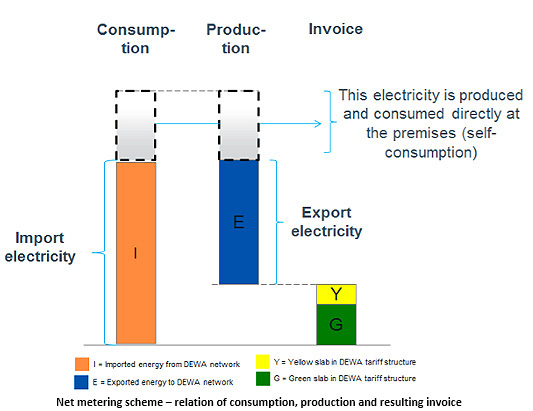
4. How will energy exported to DEWA be represented on my bill?

The electricity produced by the PV system reduces the amount of energy that a customer has drawn from the grid. If, at any point in time, more energy is produced than consumed, the excess is exported to the grid.

The monthly energy bill will only reflect the net amount of energy consumed as demonstrated in the diagram below:

How will energy exported to DEWA be represented on my bill?

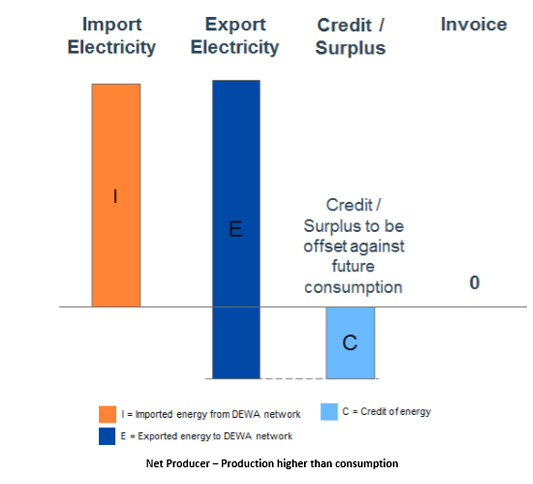
If during a billing period more energy is exported than imported, the invoiced value of electricity will be zero and the surplus electricity will be shown as a credit which can be brought forward in the following billing period as shown in the diagram below:

How will energy exported to DEWA be represented on my bill?

Net Producer – Production higher than consumption

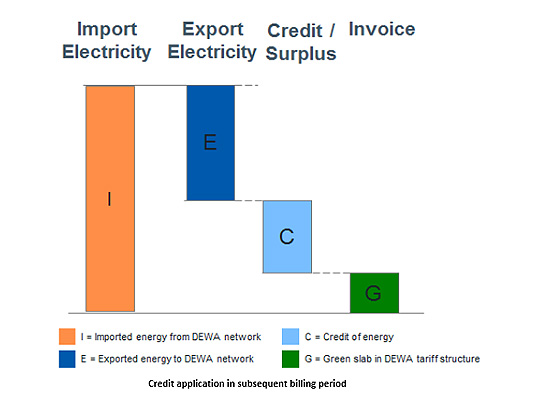
The following billing period, the credit will be offset against net consumption. 

How will energy exported to DEWA be represented on my bill?

If during the course of several consecutive months more energy is produced than imported from the grid, the credit accumulates and is carried over to the following months.

5. How will I be compensated for energy produced?

Any surplus of electricity will be offset from your bills in the following months. An indefinite rollover is applied, so any surplus will be carried forward to the next bill.

6. How is the offsetting of export electricity and electricity credits applied to the slab tariff structure?

As shown in the previous graphs electricity exports within the billing period and electricity credits carried forward from previous billing periods are deducted from the electricity imported from the grid, and only then are DEWA tariff slabs (and any applicable fuel surcharges) applied to calculate the bill. This means more savings for customers, as residual consumption is billed at lower slab rates.

For more details regarding DEWA tariffs and slabs, please visit DEWA website: https://www.dewa.gov.ae/ar-ae/consumer/billing/slab-tariff

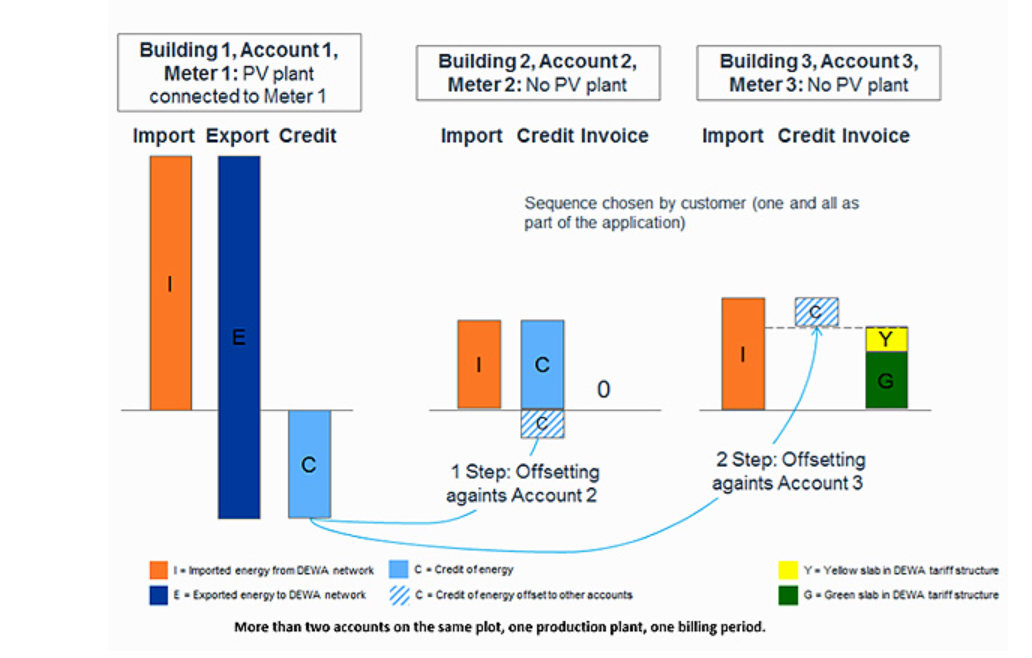
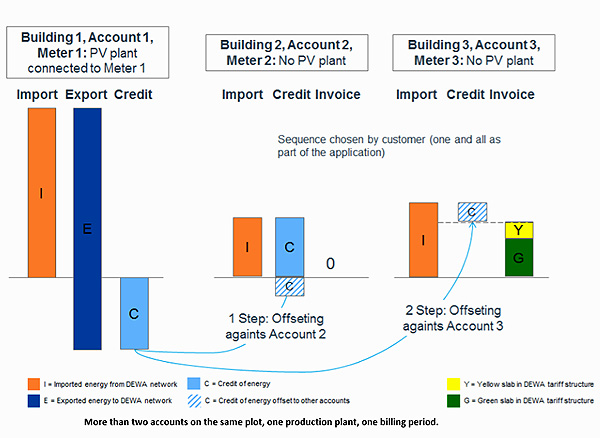
7. What if I have multiple accounts with DEWA? Can the electricity generated and exported under one account be offset against consumption of other accounts?

This is possible as long as the other accounts are also located within the same plot. In this case you just need to indicate as part of your application which other accounts you want DEWA to link to the PV generator for offsetting purposes.

8. If I have multiple accounts within a plot of land, in which order will my different accounts be offset?

The account hosting the generator is always the first one, and the order of the subsequent ones will be determined by you during the connection application process. You can optimise your total invoiced amount by choosing an order where the accounts with the highest consumption are offset first.

Please see the diagram below:

If I have multiple accounts within a plot of land, in which order will my different accounts be offset?

9. I own a residential building (or a commercial retail space) and would like to install a solar system for use by different tenants. Can you provide an applicable model that I can use?

Under current legislation it is not planned to offset electricity produced by a PV plant against electricity consumed by different customers. You can only offset electricity consumption of the common areas of the building (lighting, air-conditioning, elevators etc.) measured by the meters you own. Another option is for individual tenants to install solar systems for their own use (tied to their own accounts)

10. What if I decided to sell or rent the property that hosts a solar PV generator, What are my options in this case?

Should you decide to sell or rent the property that hosts your Solar PV generator, you can agree with the new owner or tenant to transfer your generator to their account. However, your accumulated credit cannot be transferred to the new owner’s or tenant’s account.

11. Can I install solar panels in my home/ business premises/ production facility?

PV systems can be installed in your home and in your commercial or industrial premises provided there are suitable conditions for that. PV systems can be blended into a wide range of residential, commercial and industrial building structures.

PV can be used to power your premise's electrical systems, including lights, electrical cooling systems, and appliances.

WARNING:

  • All electrical installations, operation and maintenance should be done only by qualified solar PV electricians (DEWA enrolled Electrical & DRRG Solar PV consultants and contractors).
  • Under no circumstances should the owner of the solar system interact with its components.
  • When exposed to light, photovoltaic (PV) arrays create electrical energy that cause a hazardous condition.

12. How long will it take to assemble the system?

Provided all authorisations required have been obtained, PV installations can be done quickly. A small 10 or 20 kW system can be installed within a week, while a larger, commercial or industrial system may take a few (4-8) weeks. 

13. What are the steps for installing solar systems in homes and public?

The connection procedure consists of 4 different stages: 

1. The No Objection Certificate (NOC) stage
2. The Design Approval stage
3. The Inspection and Connection stage
4. The Generation stage

For any customer interested in investing in a Solar PV generator, it is recommended to hire a DEWA enrolled Electrical & DRRG Solar PV Consultant or Contractor (List of Enrolled Electrical & Solar PV Consultants & Contractors) who will act as the customer’s agent and will advise on the best possible solution for your system. 

During the first stage, the Consultant/Contractor will gather all necessary general information and will then submit the online PV connection application form (Apply for Solar PV Connection). 

DEWA will carry out the application assessment and ensure all necessary documents have been submitted and all the criteria have been met. Upon successful completion of the assessment, DEWA will issue the No Objection Certificate (NOC). 

In the second stage, the Consultant/Contractor should submit the online Application for Design Approval (Apply for Solar PV Connection). With this application a number of technical documents need to be submitted to DEWA, such as the site plans, system design plans and details of the proposed equipment, compliance with DEWA regulations.

Upon successful completion of the application assessment by DEWA, and upon approval by the competent Authority/Entity (i.e Dubai Municipality, Trakhees, Etihad Esco etc.), the required construction and installation can begin.

In the third stage, once the installation works have been finalized, the Consultant/Contractor can apply online with DEWA for Notification for Electrical inspection and Testing, in order to proceed with the Connection. Along with this notification, the Consultant/Contractor will also be required to submit a number of documents, including the completion certificate from the concerned building Authority and the Shams Dubai Connection Agreement signed by the customer. Once DEWA finalises the assessment, meters will be installed.

The final stage begins once DEWA has installed the meters. The solar system will be generating electricity, and DEWA will be also considering any surplus generation fed into the grid for the purpose of offsetting against the customer’s consumption.

You will also be required to submit the signed Connection Agreement with DEWA, which sets out the net metering arrangement and the responsibilities of both parties. 

In addition, you will be required to present a signed Operation and Maintenance Contract as well as the Operation and Maintenance Manual provided by your Consultant and / or Contractor. For more details please refer to (DEWA DRRG Connection Guidelines

Snapshot of the Connection Process:

14. Is there any limit to the size of the PV system that I can install?

As per the Shams Dubai Connection Conditions (Publications & Resources) the capacity installed cannot exceed the applicable share of the Total